

Why the Wall and Ground Courtyard Matter in Homes
This article is a continuation of Part One, which you can find here.
Life Dimensions
The wall and courtyard (ground-level yard) in ancient urban civilizations and modern societies provide an important outlet for the home’s residents, and they constitute active and passive architectural elements that influence daily life.
The wall and ground-level yard are considered a highly utilized space for a wide range of daily life activities—developing the mind, recharging the self—and they also offer significant economic benefits.
The outer wall and courtyard enhance the quality of life for individuals, the family, and the surrounding environment. The wall transforms the home into a social fortress for those inside and creates a mental and psychological separation from the outside world—the public world of strangers and the private world of family. The world of work, effort, and noise versus the world of rest, quiet, and tranquility.
Neighborhoods and homes were called “residential” because a person settles in them physically and mentally as soon as they enter. From the moment one enters the neighborhood street until reaching the home’s door (this characteristic has begun to disappear from Kuwaiti neighborhoods).
The wall and ground-level yard form a garden and playground for the family’s enjoyment without having to step outside the door—into gatherings on the public sidewalk (an encroachment on state land!) or wandering through malls, cafés, restaurants, and markets like adolescents and vagrants at all times.
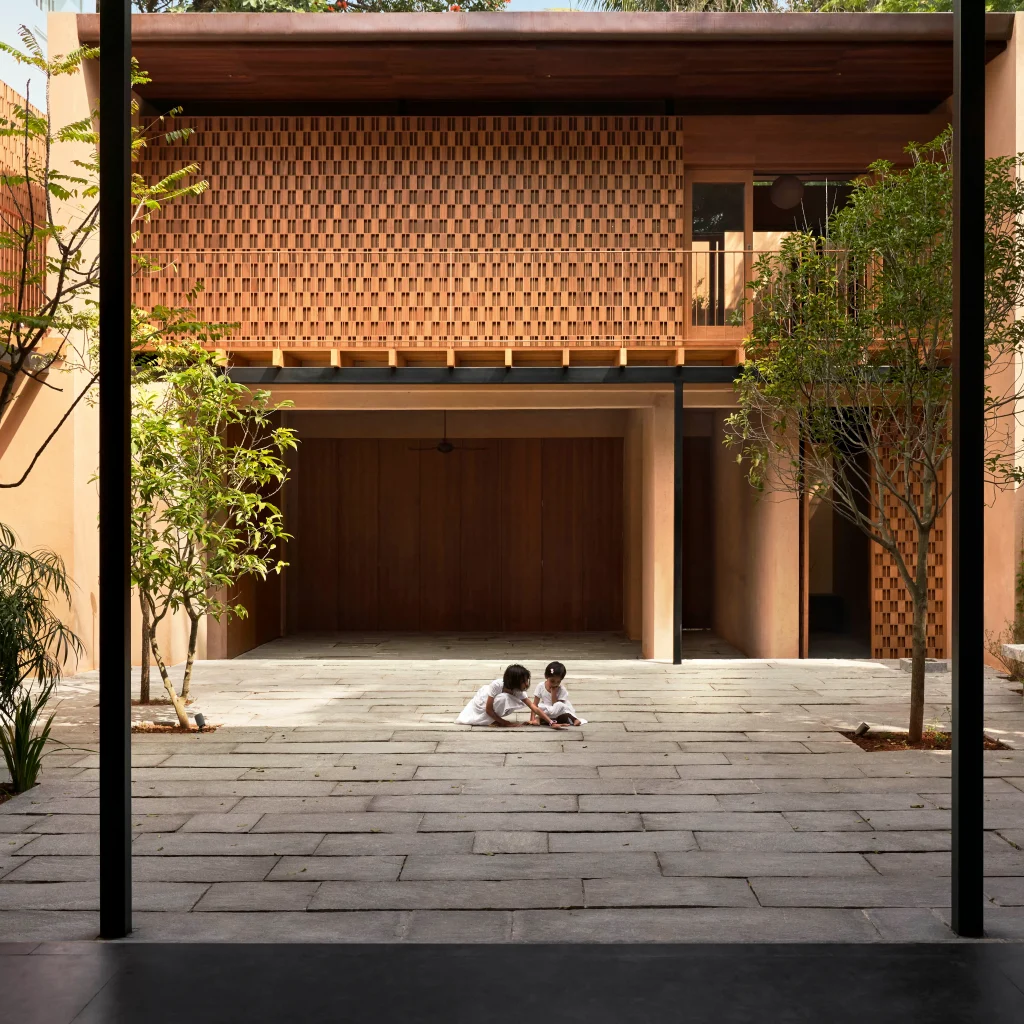
The ground-level yard offers multiple advantages and importance over a rooftop yard. It reduces costs from construction through operation and maintenance. It also has practical everyday uses that a rooftop yard does not provide (play, storage, parking, individual hobbies, and social activities, etc.). In addition, the ground-level yard can be planted with trees that soften and purify the home’s air, bring beauty and psychological comfort, attract birds, cool the house in summer, and warm it in winter.
Eliminating the ground-level yard due to high land and property prices is more costly to life, health, and the budget than the cost of the land itself.



Social and Cultural Risks
Buildings and homes reflect the culture of the individual and society—the country’s history, civilization, and future (architectural identity). Therefore, governments, municipalities, and civil societies handle them with great care.
As for these concrete burrows and boxes now widespread in Kuwait, they are often unrelated to sound architecture, Arab society, or the Islamic faith. They distort concepts of privacy, housing, and safety in the minds of children and the family, erasing them from their thinking and depriving them of very important human experiences connected to the built environment and the interior surroundings.
Removing structural elements such as the wall and inner yard from homes removes the intellectual space that separates private life from public life—between what is permissible and what is not, between what is acceptable and what is unacceptable, and gradually between what is lawful and what is forbidden—until the only intellectual reference becomes the individual’s own “mood and desire.” This condition is common in Western societies.
For example, in the past it was considered improper to open the front door wearing indoor clothing. Now we see homewear in public places and perhaps even in formal workplaces, or the invention of strange social behaviors under the claim of “personal taste.” These are practical manifestations of how removing separation in building design translates into negative human behaviors.
“Beware of sitting in the roads”


The Prophetic hadith and good customs forbid sitting in public streets, especially within residential neighborhoods. It is an ugly practice, frowned upon by people of chastity, respect, and dignity. These are commendable human traits not exclusive to the East and Islam, even if they are less common elsewhere.
Unfortunately, street gatherings have shifted from teenagers and street youth to home designs where living rooms face the street, and entire families sitting on the sidewalk as a direct result of eliminating the ground-level yard and wall.
It is a major social and civilizational disaster, justified under the claim of architectural “modernity” and comfortable living, or non-interference in the use of private property (while violating public land is deemed permissible!).
Homes are a direct reflection of a society’s mindset, culture, and religion, yet most people may make the wrong choice.
Allah the Exalted said regarding the people of Thamud: {And they used to carve from the mountains houses, feeling secure} (Al-Hijr: 82), and {And you carve from the mountains homes with skill} (Ash-Shu‘ara’: 149).
How similar Kuwaiti “modern” homes are to the homes of the people of Thamud. We hope the outcome will not be similar.

