Part Four: Cities in the Desert Instead of a Green Belt
The 2005 review of the country’s Third Master Plan approved a green belt around the urban area [1], but only 40% of the plan was implemented, according to the Municipal Council [2]. Instead of completing the belt, the government proceeded to build residential cities in the heart of the desert and other barren areas.
Cities such as Al-Mutlaa, Sabah Al-Ahmad and Al-Khiran, promised to be “environmentally friendly,” filled up with rows of identical, box-like houses, with highways, bridges and tunnels leading to them, surrounding them and cutting through them [3].
More is to come: the cities of Al-Khiran, Nawaf Al-Ahmad and Al-Sabriya cover 340 square kilometers [4][5], or roughly two-thirds of all the land built up and paved in Kuwait by 2022 [6]. A total of 87,441 housing units were delivered over ten years, and Al-Mutlaa alone contains 28,288 residential plots, while approximately 105,000 housing applications await their turn [7].

The need for housing is real, but the question is whether the crisis is a shortage of residential land, or whether it stems from a small country behaving as though it were a vast continent, importing unlimited numbers of workers, most of them low-skilled, and exhausting the limited usable land in the traditional urban area and its immediate surroundings.
This urban expansion consists of leaps rather than organic growth. It differs from the expansion beyond Kuwait’s old city walls in form, method and its consequences for urban life. This does not mean Kuwait lacks land, but the land suitable for settlement is limited and constrained.
According to the latest statistics from the Public Authority for Civil Information, the population has reached 5.3 million, 70% of whom are expatriates (80% are low-skilled workers), crowded into a small area of usable land. Every one of them needs air-conditioned housing and uses private vehicles that emit heat and pollutants, increasing demand on power generation and water production facilities and their carbon dioxide emissions.

For comparison, Oman, which is approximately 17 times the size of Kuwait, had a similar population of approximately 5,398,645 at the end of June 2026 (56.75% Omanis and 43.25% expatriates) [8].
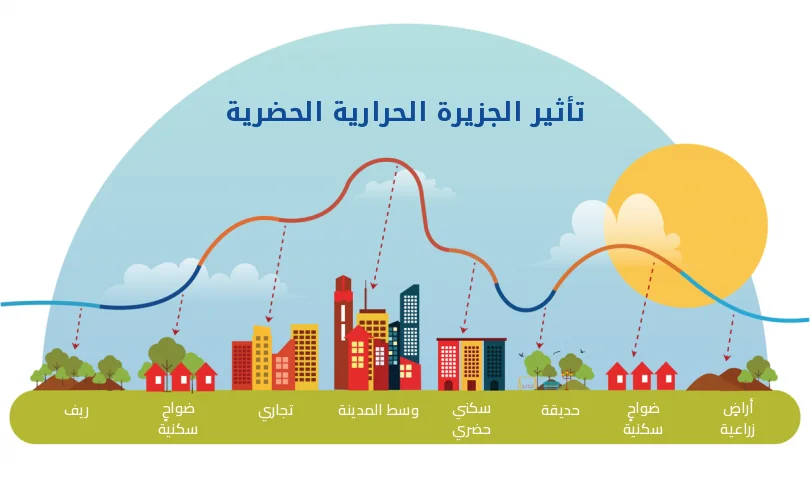
Dust has not increased steadily, as many believe; it rose until around 2010 and then declined [9], with its peak linked to a prolonged drought in Iraq and Syria [10]. However, the absence of vegetation increases the impact of dust [11], providing another argument for the green belt (see illustrations).

For those who claim that “this is natural and good for the country’s economy,” the figures suggest otherwise. The constant justification for bringing in more workers, constructing larger buildings and widening roads is that these are signs of strong economic activity. Yet real GDP per capita fell from approximately $40,500 in 2005 to approximately $24,100 in 2024 [12].

The budget recorded a deficit of 10.8 billion Kuwaiti dinars in the 2020/2021 fiscal year [13]. Comparisons with Dubai or our neighbors are invalid without considering the area and geography of land suitable for development, the weakness of Kuwait’s non-oil economy and the extraordinary pressure on services.
Meanwhile, prices have risen and personal expenses have ballooned. Even falafel and samosas have shrunk!
The good news is that all these factors, and this entire situation, are human-made and can be reduced and eliminated so that the weather and daily life can return to normal.
References
[1] United Nations Human Settlements Programme, UN-Habitat: Kuwait National Report for the Habitat III Conference (Third Master Plan, 2005 review).
https://unhabitat.org/sites/default/files/documents/2019-08/national-report-asia-pacific-kuwait-final-in-english.pdf
[2] Al-Jarida: “The Fourth Master Plan 2040 Is Not Ready” (2019).
[3] Al-Anba.
[4] KUNA (April 29, 2025): New Residential Cities.
https://www.kuna.net.kw/ArticleDetails.aspx?Language=ar&id=3228175
[5] Public Authority for Housing Welfare: Future Projects.
[6] Organisation for Economic Co-operation and Development (OECD), Land Cover (ESA CCI satellite data), Kuwait.
[7] Al-Jarida (November 5, 2026): Housing Welfare.
[8] Oman News Agency: The Sultanate of Oman’s Population Exceeds 5.3 Million.
[9] NASA, NASA POWER platform, MERRA-2 reanalysis (aerosol optical depth), Kuwait.
[10] Notaro, M. et al. (2015). Regime shift in Arabian dust activity, triggered by persistent Fertile Crescent drought. J. Geophys. Res. Atmos.
[11] Impacts of meteorology and vegetation on surface dust concentrations in Middle Eastern countries.
[12] World Bank: GDP per capita (constant 2015 US dollars).
https://data.worldbank.org/indicator/NY.GDP.PCAP.KD?locations=KW
[13] Reuters, citing the Ministry of Finance: 2020/2021 budget deficit reaches 10.8 billion Kuwaiti dinars.
[14] Esri World Imagery Wayback satellite imagery archive.
